A research report using a short-drama probe
points out its own problems
The starting point was a third-party research report that proposed using the diction differences between "human short dramas vs. AI short dramas" to predict the evolution of popular speech styles. This report was commendably self-critical: short dramas use highly formulaic "stage colloquialisms," the causal chain from viewers watching a drama to internalizing its dialogue has never been validated, and three confounding factors—subject matter, audience, and production process—are all mixed together, making it impossible to tell whether the measured diction differences are actually caused by AI pollution.
The report itself suggested a corrective direction: switch to a cleaner probe that directly tracks the diffusion path of AI-generated content into human language. This study executed that recommendation, replacing the probe with the diffusion process of the same news story along the media propagation chain: AI lab official release → professional tech media → Chinese AI vertical media → social/short-video platforms, tracking the same event across four layers, which fundamentally eliminates the subject-matter confounding problem of the short-drama probe.
Four-layer chain,
same-event pairing
Tier0 is the lab's official release (OpenAI/Anthropic/Google DeepMind blogs, DeepSeek/Alibaba Tongyi/Zhipu/Tencent official channels); Tier1 is professional tech media (TechCrunch/The Verge/Ars Technica, or Geekpark/Caixin/36Kr); Tier2 is AI vertical media like Qbit; Tier3 is social/short-video diffusion on Douyin, Xiaohongshu, Weibo, and Bilibili, scraped via the TikHub API.
Four research questions: Does AI diction fingerprint density change monotonically across tiers (RQ1); do downstream texts quote upstream verbatim or rewrite independently, and is this "paraphrase distance" related to AI flavor (RQ2); do specific numbers (parameter counts, benchmarks, prices) degrade along the chain (RQ3); does AI flavor/exaggeration affect engagement, and does "obviously AI" backlash appear in comments (RQ4).
Data scraping had one hard rule: never use any scraping tool that first passes content through a small model for summarization or rewriting—including WebFetch. Since we're measuring the degree of LLM pollution, using an LLM tool to scrape raw text would secretly inject an unrecorded layer of AI rewriting into the measurement baseline. All web page body text was instead extracted using raw HTTP requests + trafilatura; when encountering anti-scraping mechanisms (Cloudflare human verification, 36Kr's drag-puzzle CAPTCHA), we never bypassed them, directly recording them as unavailable data sources.
From 12 events to 29,
from 353 texts to 1,040
The pilot version covered 12 events (November 2025–August 2026, 7 English + 5 Chinese). The expanded version added 17 events, pulling in two directions: adding previously uncovered labs (xAI Grok 4, Meta Llama 4, Mistral 3, Moonshot Kimi K2/K3, MiniMax M2, Baidu Wenxin 5.0, Amazon Nova 2, Perplexity Sonar API), and extending the time window to earlier events from the same labs (GPT-5/5.1, Claude Opus 4.5/Sonnet 4.5, Gemini 2.5 Pro, DeepSeek V3.2, Qwen3 first generation, GLM-4.6). The time span stretched from 6–9 months to 20 months.
| Tier | v1 Pilot | v2 Expanded | Notes |
|---|---|---|---|
| Tier0 Official Blogs | 9 | 29 | Recovered all OpenAI official blogs using real browser sessions |
| Tier1 Tech Media | 19 | 52 | |
| Tier2 Vertical Media | 15 | 36 | |
| Tier3 Social/Short-Video | 210 | 823 | Top 15 per platform; v1 was Top 5 |
| Product Recommendation Supplement | 100 | 100 | Not expanded; see §05 |
| Total | 353 | 1,040 | ~228k words |
Deepening the Tier3 sampling depth (Top 5 → Top 15) did not increase API call costs—TikHub's single search already returns 15–20 raw results, and the pilot only used the first 5. The real effort went into recovering intercepted sources: using real browser sessions (reusing logged-in state, not headless spoofing) to retry URLs that previously returned 403. All 5 OpenAI official blogs, the Meta AI Blog, and the Perplexity website rendered normally with no human verification challenges—indicating the original 403s were simple UA filtering against default request headers, not strong anti-scraping requiring "cracking." However, some 36Kr pages triggered an explicit drag-puzzle CAPTCHA under real browsers; after screenshot confirmation, this study chose not to solve it, directly recording them as unavailable data sources.
What held up,
and what didn't
RQ1 · Fingerprint density peaks at the source; direction holds, magnitude revised downwardDirection Holds
Across 19 English events, the mean AI diction fingerprint density for official blogs (Tier0) was 1.59 per 1,000 words, dropping to 0.94 per 1,000 words after professional media paraphrase (Tier1)—a 41% decrease (Wilcoxon p=0.125; direction highly consistent across 19 events, but still not past 0.05). In the pilot with n=4, it appeared to plummet by 73%; now that looks more like an exaggeration effect from small-sample variance.
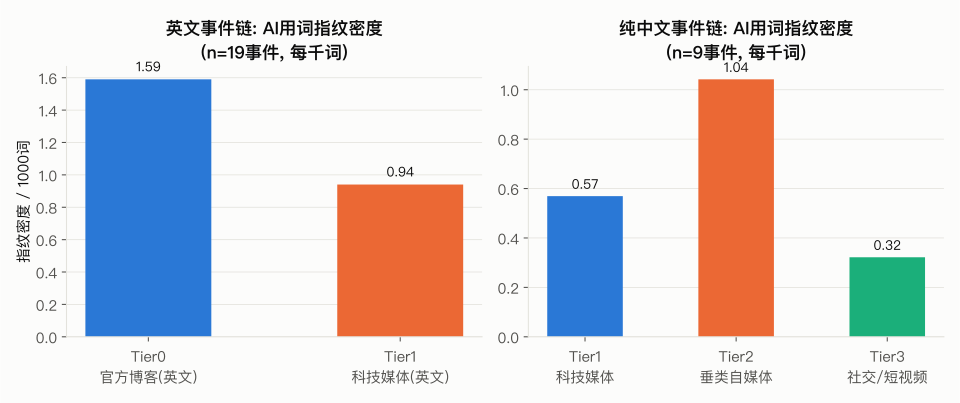
Source: This study's raw data (
data/processed/stats_summary.json, not publicly released; see note at end)The pilot phase with n=7 computed ρ=-0.80, p=0.03; after expanding to n=22, this became ρ=+0.16, p=0.47—direction reversed, original conclusion does not hold.
RQ2 · Paraphrase Distance vs. AI Fingerprint Density Not Replicated
Based on 7 events, the pilot observed a strong negative correlation of "greater Tier2→Tier3 paraphrase distance → lower Tier3 AI fingerprint density," which overturned the original report's conjecture that "vertical media just has LLMs rewrite articles." After expanding to 22 events, the correlation coefficient not only attenuated but reversed direction to a weak positive correlation, far from significant. The honest conclusion is: existing data does not support any stable linear relationship between paraphrase distance and AI fingerprint density—neither the positive correlation conjectured by the original report, nor the negative correlation observed in the pilot.
RQ3 · Numeric fidelity weakens along the chain, but the trend is weaker than expected
Using "salient numbers" published at Tier0—parameter counts, benchmarks, prices—as the baseline, cross-event trend tests on retention ratios at downstream tiers: pilot n=25 observations, ρ=-0.27, p=0.19; expanded n=77 observations, ρ=-0.13, p=0.28—direction unchanged, but strength further weakened. One robust qualitative pattern: sources dense in technical parameters (e.g., Qwen3.7's 25-minute, 192-number long blog) see their downstream retention rates diluted most heavily; sources publishing only a few key numbers (e.g., DeepSeek-V3.2-Exp) retain over 50%.
Exaggerated headlines drive higher engagement—this near-tautological common sense couldn't hold up on 823 data points either.
RQ4 · Exaggeration Word Density vs. Engagement Not Replicated
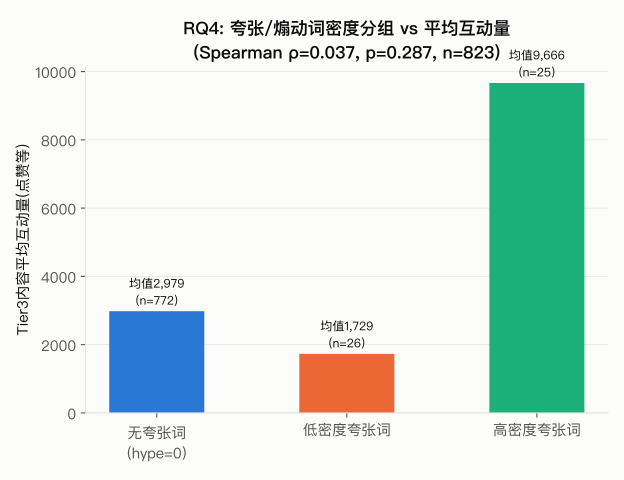
Source: This study's TikHub scraped data, Douyin/Xiaohongshu/Weibo/Bilibili
The pilot computed a significant positive correlation with p=0.009 from 210 data points; after expanding to 823, this dropped to p=0.29. AI diction fingerprint density was consistently unrelated to engagement (pilot p=0.84, expanded p=0.34, consistent across both versions)—this null result is actually one of the most robust findings in this study. We can fairly confidently say that, at least in this corpus, "AI-speak" does not affect propagation effectiveness.
"Obviously AI" backlash in comments: 325 comments, 0 true positives
Expanding the comment sample from 11 videos/220 comments to 21 videos/325 comments and scanning for phrases like "obviously AI / AI-written / no human feel" yielded 4 suspected hits; manual review found all were "awkward sweat" emoji memes triggering an overly broad match on the character "尬"—not a single comment was actually accusing the script of being AI-written. Spot-checking actual comments revealed that audiences under "AI model news" videos were discussing the DeepSeek vs. OpenAI price war, completely indifferent to script style. This backlash phenomenon is likely genre-specific, not a universal popular rejection of AI writing style.
Product recommendation notes:
the only finding that "graduated"
We additionally collected Xiaohongshu data for 5 gadget categories (phones/earbuds/laptops/smartwatches/camera reviews, 100 notes) and ran a genre contrast against AI news notes on the same platform from the main experiment's Tier3, testing whether "pollution level is more a property of content type or of platform."
| v1 Pilot | v2 Expanded | |
|---|---|---|
| AI news note sample size | n=58 | n=309 |
| AI fingerprint density: Product rec. vs. AI news notes | p=0.28 not sig. | p=0.013 Significant |
| Exaggeration word density: Product rec. vs. AI news notes | — | p=0.056 marginally sig. |
On the same platform, product recommendation notes have significantly higher AI diction fingerprint density, while AI news reaction notes have higher exaggeration/sensational word density (marginally significant)—this supports "content genre predicts pollution patterns better than the platform itself." It also shows that not all pilot findings disappear upon expansion; some, like this one, go from "trend" to "significant"—the difference often lies in whether the underlying effect is real.
The keyword method itself
has systematic bias
Manual cross-validation revealed two clear types of misjudgment: DeepSeek's official website uses a telegram-style changelog with almost no rhetorical padding—human judges rated it as highly native—yet technical terms coincidentally hit the word list, producing the second-highest fingerprint density in the entire sample (false positive); Anthropic's official blog has a pronounced generic corporate-copy feel, but its diction falls outside the 60-word list, yielding a fingerprint density of 0 (false negative). This confirms the prediction that the Chinese vertical media "de-AI-ification" arms race would cause pure keyword methods to systematically underestimate pollution levels—pure keyword density cannot serve alone as conclusive evidence of pollution degree.
The backlash keyword list exposed similar precision issues: the single character "尬" misclassified unrelated emoji usages like "尴尬流汗" (awkward sweat) and "尬笑" (forced laugh) as "AI flavor" accusations. Future work should switch to longer phrase matching or a classification model.
This study uses an observational design; even expanded to 29 events, it remains far below the scale required for strong causal inference, and all conclusions should be treated as exploratory findings. The most important methodological lesson from this expansion: p-values and correlation coefficients from most statistical tests are extremely unstable when n<10; any "surprising significant result" should be treated as a hypothesis until replicated on an independent or larger sample—including the two findings from this report's own v1 that were later overturned.
Directions worth
digging into
Training data / model collapse feedback loop—if AI labs' official release copy is itself a "pollution source," and that copy gets scraped to train the next generation of models, "AI polluting its own published PR copy" may be a feedback loop more easily overlooked than "AI polluting popular language," but verifying it requires access to training infrastructure.
The AI generation share of product recommendation notes deserves independent expansion to more categories and larger samples, calibrated against platforms' official AIGC labels. Longitudinal tracking of "AI word渗透" in Chinese corpora remains an academic gap; this study's methodology (same-language adjacent-tier similarity + numeric fidelity + LLM-judge cross-validation) can be directly reused, simply replacing cross-sectional event samples with longitudinal quarterly tracking corpora.