If you've just walked out of the Gaokao exam room, congratulations. The next thing that will anxiety your whole family more than whether you finished your essay is: choosing your college major. AI has already shattered the logic of your parents' generation—"pick a stable, good major." But "studying AI guarantees a future" isn't true either. This article won't give you a list of "the top 10 safest majors"—those rankings churn every year. What it does is translate the most rigorous findings from 4 academic papers (the AIOE framework) about "which jobs are changing" into a college application decision you can actually discuss with your family.
This article builds on the site's existing All-Occupation AI Exposure Ranking: 5-Source Data Comparison dashboard (889 O*NET occupations × 5 independent AI exposure studies). That piece is the data foundation; this one is the application layer. They're best read together.
TL;DR · 30-Second Read
Core thesis: In the AI era, don't bet on "what AI can't do"—bet on "what lets AI work for you."
- What is AIOE: Four independent teams (Eloundou/OpenAI, Felten/Princeton, Webb/Stanford, Daron Acemoglu/MIT) used four completely different methods to measure "how many tasks in each occupation will be affected by AI." The conclusions are highly consistent: the most exposed are highly educated white-collar workers, not manual laborers.
- High AIOE ≠ low income: Lawyers / financial analysts / accountants' BLS 2024 median salary remains in the U.S. top 25%; exposure measures "how much AI can help you," not "how much AI will replace you."
- The real moat: Licensing barriers (physicians/lawyers/teachers/registered engineers) + physicality + complex judgment = the triple shield hard to replace in the short term.
- Chinese context differences: U.S. entry-level white-collar jobs are collapsing, but China's AI industry is still expanding rapidly—2025 new AI job postings YoY +543%. Those enrolling in 2026-2030 will catch this wave, but the "hourglass effect"—stable top and bottom, hollowed-out middle—is playing out domestically too.
- Counter-consensus insight: Graduates from top-tier universities reading "the most unsafe majors" still have better employment outcomes than those from lower-tier universities reading "the safest majors." AIOE research completely ignores school signaling—this is its biggest blind spot.
§ 01 What is AIOE — 4 Papers, One Picture
AIOE = AI Occupational Exposure. Not a single index, but a methodology family: quantifying in various ways the extent to which AI can replace or accelerate tasks within a job. Four teams, four independent routes:
1. Eloundou et al., GPTs are GPTs (OpenAI/Penn, 2023)
This is currently the most-cited "LLM × U.S. labor market" exposure study. The authors constructed a three-tier scoring system: E0 = LLM can't help; E1 = using ChatGPT directly can cut task time ≥50%; E2 = requires specialized software layered on top of the LLM (code IDE, RAG, Agent) to cut ≥50%; the subsequently extended E3 = requires image/multimodal.
Core conclusion: approximately 80% of the U.S. workforce will have ≥10% of tasks affected by LLMs, approximately 19% will have ≥50% of tasks affected; using LLMs alone can accelerate 15% of tasks, and with LLM-powered software this rises to 47-56%.
What this means for your college application: Exposure measures "how much AI can help you," not "how much AI will replace you." A high E1 score can be read as "mastering AI multiplies your efficiency."
2. Felten / Raj / Seamans AIOE Series (Princeton/NYU, 2018-2023)
Original methodology 2018 → 2021 formally published in Strategic Management Journal. They mapped the 10 AI capability subfields tracked by the Electronic Frontier Foundation to 52 O*NET human abilities (oral comprehension, inductive reasoning, manual dexterity…) via crowdsourced association, then projected onto 873 occupations.
The 2023 update for ChatGPT (Occupational Heterogeneity in Exposure to Generative AI) yielded a counterintuitive conclusion: the most exposed are not factory workers, but literature professors. Telemarketers top the exposure list, closely followed by post-secondary teachers in English literature, foreign language literature, and history.
3. Michael Webb, The Impact of AI on the Labor Market (Stanford, 2020)
The third route: using AI patent text × O*NET task descriptions for semantic matching, counting how many tasks in each occupation overlap with existing AI patents. The most counter-consensus finding: unlike software/robotics that primarily target mid-to-low skills, AI specifically targets high-skill tasks; if trends continue, AI would actually narrow the 90:10 wage gap, but with almost no impact on the top 1%.
4. Daron Acemoglu, The Simple Macroeconomics of AI (NBER w32487, 2024) — The Conservative
MIT's Daron Acemoglu uses Hulten's theorem to estimate: AI's cumulative contribution to total factor productivity (TFP) over the next 10 years has an upper bound of only 0.53%–0.66%, annualized even less than 0.07%—far below Goldman Sachs's optimistic estimate of "GDP +7%, 300 million jobs replaced". His critique: early productivity experiments all focused on "easy-to-learn" tasks (customer service templates, code completion), but the real difficulty lies in hard-to-learn, context-dependent tasks where there is no objective outcome measure, and AI can't help much.
For parents filling out college applications: Even if you believe AI will reshape work, the total output shock over the next 10 years isn't as large as imagined—no need to panic-reshuffle the family's entire career plan.
A Comparison Table
| Paper | Measures | High-Exposure Examples | Policy Implication |
|---|---|---|---|
| Eloundou 2023 | How much LLMs can cut task time | Programmers (highest E1), journalists, paralegals | "Mastering AI tools multiplies output" |
| Felten 2023 | Task × AI capability association | Telemarketing, English lit professors, foreign language teachers, history professors | "The more elite the white-collar, the more exposed" |
| Webb 2020 | Task × AI patent semantic matching | Chemical engineers, robotics technicians, market researchers | "AI narrows the 90:10 wage gap" |
| Acemoglu 2024 | Aggregate TFP upper bound | / | "Impact isn't as big as you think: 0.66% over 10 years" |
The four teams exhibit both divergence (Daron Acemoglu is an order of magnitude more conservative than Eloundou) and consensus (highly educated white-collar workers are most exposed). Anyone who tells you "AI will definitely replace X major" or "AI will definitely not replace X major" hasn't read any of these four papers.
A January 2026 data point (as of this update, Anthropic has not yet released an updated version): The Anthropic Economic Index January 2026 report shows 49% of occupations are already using Claude for ≥25% of tasks (up from 36% in January 2025); in November, the augmentation vs. automation ratio flipped to 52% vs. 45% (augmentation-dominant, not replacement). Actual usage data is currently falsifying the "AI replacement narrative"—at least for now.
Data sources: Acemoglu NBER w32487 · Webb 2020 · Goldman Sachs 2023 · Eloundou 2023
Data source: Understanding AI (Tim Lee) · U.S. recent graduate data
Data source: Brynjolfsson/Li/Raymond 2023 (NBER w31161)
Based on § 06 synthesis in this article (not a single data source; qualitative visualization for comparison)
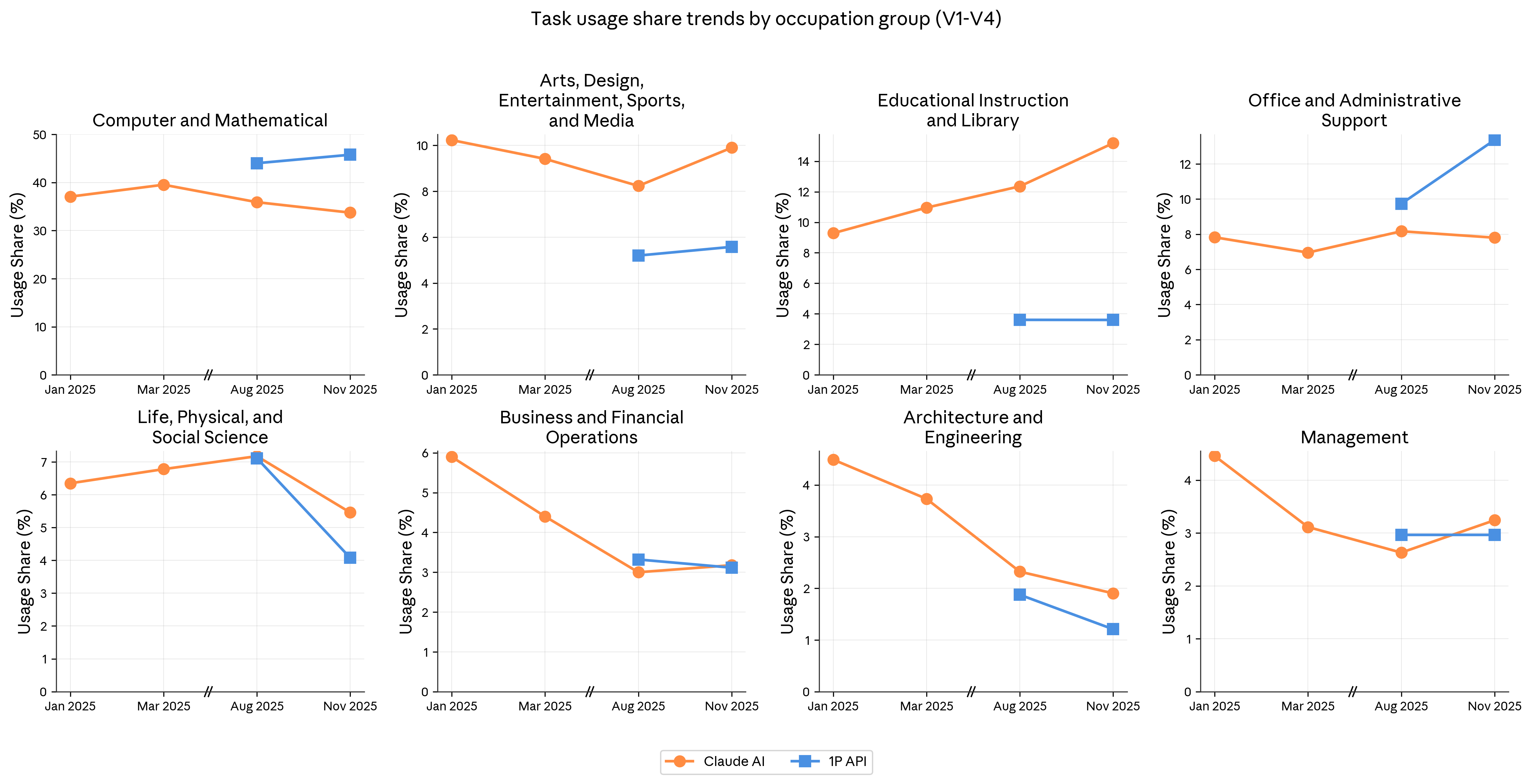
Source: Anthropic Economic Index, January 2026
§ 02 Translating AIOE Scores to the Major Level — High/Medium/Low Exposure Major Table
High-Exposure Majors (White-Collar "Knowledge" Work)
Brookings' Mark Muro in 2024, synthesizing Eloundou/Felten data, clearly states: high-salary, high-education white-collar jobs are most exposed—specifically non-programming STEM roles, business/finance, architecture/engineering, legal services, and mid-salary office administration. The article specifically names bookkeepers, legal secretaries, HR assistants, bank tellers, payroll clerks.
Pew Research 2023 re-scored using 41 O*NET work activities: 19% of U.S. workers are "high exposure," 23% "low exposure"; high-exposure examples: budget analysts, data entry, mechanical drafting, legal assistants, web development. Among college-educated workers, 27% are high-exposure, vs. only 12% of high-school-educated workers—more education no longer inherently = safer.
Data source: Pew Research Center 2023-07-26
Brookings also has gender data: 36% of women vs. 25% of men are in jobs where "50% of tasks could be saved by AI"—because women are more concentrated in white-collar clerical roles.
Corresponding Chinese undergraduate majors (inferred from the AIOE framework): Accounting, Taxation, Auditing, Financial Analysis (non-trader track), Journalism, Advertising/Marketing, Translation, Law (basic compliance + clerical roles), Public Administration, Chinese Language and Literature (except teacher track), Visual Communication Design (template-driven portions).
Medium-Exposure Majors
Software Engineering / Computer Science / Data Science is a special case. Eloundou gives programmers the highest E1 score, but Brookings also notes this group is "AI-complementary" rather than "AI-substitutable"—because they write the AI tools themselves.
Actual data is even more counter-consensus: since ChatGPT launched, total U.S. software developer headcount grew 7%, but recent CS graduates have a 6.1% unemployment rate—higher than English (4.9%) and performing arts (2.7%). The total pie is growing, but the entry point is narrowing—seniors appreciate, juniors shrink.
Data source: Understanding AI (Tim Lee) · U.S. recent graduate data
Data source: Brynjolfsson/Li/Raymond 2023 (NBER w31161)
Based on § 06 synthesis in this article (not a single data source; qualitative visualization for comparison)
This pattern isn't limited to CS—medicine, design, and education are all experiencing the same bifurcation internally: senior doctors' wages are rising, junior residents face unprecedented pressure; senior designers with AI tools are more valuable, junior designers are being replaced; veteran teachers have accumulated reputation, new teachers face parents questioning "why not just let the child learn with AI."
Low-Exposure Majors
Pew explicitly lists the least-exposed: barbers, childcare workers, nannies. Brookings: blue-collar, physical work "almost unaffected".
Corresponding Chinese undergraduate majors: Nursing, Rehabilitation Therapy, Stomatology, Clinical Medicine (surgery / emergency / anesthesiology / ICU tracks), Psychology (clinical counseling), Social Work, Preschool Education, Electrical Engineering and Automation (on-site construction), HVAC / plumbing / marine electromechanical, Veterinary Medicine, Culinary and Nutrition, TCM Acupuncture and Tuina.
A Counterintuitive "High Exposure ≠ Unemployment" Example: Radiologists
Ten years ago Geoffrey Hinton publicly predicted "we should stop training radiologists right now"—but in 2026 the radiologist median salary rose to $571K, and job count has grown 10% since ChatGPT; Jensen Huang in a December 2025 public interview used this example to rebut "AI destroys jobs" panic.
Source: CDL official channel (approx. 1.5 min)
"In 2016 they said we don't need radiologists… now we have a historic shortage of radiologists. AI is one of the technologies that **creates the most work for humans** in history."
Source: CNBC report 2025-12-04 (Joe Rogan show subject to exclusive platform contract; cannot embed off-platform)
The same story is playing out with paralegals: since ChatGPT launched, U.S. paralegal job count grew 21%—despite Pew/Felten both rating it high exposure.
This lesson is crucial for families filling out college applications: high AIOE means the "routine clerical work" in that profession will be taken over by AI, but the parts requiring professional judgment, trust, and accountability become more valuable instead.
§ 03 Three Key Adjustments for the Chinese Context
All four papers above use U.S. O*NET data. Directly transplanting to China will distort results; three main differences:
Adjustment 1: China's LLM Industry Is Still Expanding Rapidly
January-October 2025, China's new AI job postings YoY +543%; algorithm engineer and LLM algorithm positions hold steady at #1 and #2, AI product manager YoY +178%. AI sector new job average monthly salary ¥61,764, 35.59% higher than the new economy sector; LLM algorithm salary ¥68,959, AI scientist salary over ¥127,000; Maimai data shows over half of AI fresh-grad positions offer monthly salary >¥50,000.
This is the biggest difference from the U.S. "entry-level white-collar collapse" narrative. China's AI industry in 2024-2028 is in a "far too few talents" window. If you enroll in AI / CS / Data Science / Automation / Electronic Information in 2026, you'll likely still be in this window when you graduate in 2030.
But a warning: the window isn't permanent. Whether these positions "continue expanding" or "begin saturation" after 2031, no one can guarantee today. So your major choice must preserve migration capability (see § 06).
Adjustment 2: Chinese Blue-Collar Wages Are Catching Up
2025 China: postpartum caregiver average monthly salary ¥10,128; delivery driver ¥8,325; truck driver ¥8,279; delivery driver 3-year CAGR >10%. Blue-collar vs. white-collar average monthly income gap narrowed from 2013 peak of ¥3,344 to 2025 ¥2,250 (−32.7%); blue-collar income growth has exceeded white-collar for 7 consecutive years.
U.S. mirror: post-2022 ChatGPT, U.S. added 3M white-collar jobs, blue-collar flat; but entry-level white-collar jobs (requiring <1 year experience) dropped 50%. Both sides are playing out the same drama: "top + bottom" both stable, "middle" being hollowed out.
The implication for college applications isn't "make your child study to be an electrician"—but rather to acknowledge that the return on vocational education, associate degrees, and skilled trades is structurally rising, and "going to a four-year university" needn't be the only correct path. If family circumstances + student interest allow pursuing high-quality associate programs in electromechanical, auto repair, nursing, medical technology, or dental technology, the outcome may be better than forcing into a second-tier university's "safest major" bachelor's program.
Adjustment 3: Policy Moats — "Licensed Professions" Are Deeper and More Opaque in China
These majors have legally protected barriers against direct AI replacement in the Chinese context. Unlike the U.S.: U.S. medical residency caps are controlled by ACGME; China's are jointly controlled by the Ministry of Education + National Health Commission + Ministry of Human Resources—equally deep moats but more opaque (meaning for you: higher entry barriers, and post-graduation "certificate premium" is also more stable).
The "Interim Measures for the Management of Generative AI Services" (jointly issued by seven ministries) taking effect August 2023 introduced algorithm filing, safety assessment, data annotation, and content review as entirely new compliance roles at the AI regulatory level—these are among the few still-growing sub-segments within law, cybersecurity, and media majors.
The Ministry of Education began promoting "New Engineering / New Medicine / New Liberal Arts / New Agriculture" construction in 2018, and released the "General Higher Education Discipline and Major Setting Adjustment and Optimization Reform Plan" in 2023—this is the state aligning policy toward majors that "interface with AI above, connect with physicality below." Among newly added interdisciplinary majors, "Embodied Intelligence" became the most watched new major, with 9 universities (including HIT and BUAA) opening it simultaneously.
§ 04 Five Counter-Consensus Insights — What You Think Is "Safe" Is Actually Most Dangerous
Counter-Consensus 1: High AIOE ≠ Low Income
May 2024 BLS OEWS data: U.S. lawyer median salary $183,890, financial analyst $101,350, accountant and auditor $81,680—all far above the U.S. median of $49,500. These are all high-AIOE-exposure occupations, yet wages remain in the national top 25%.
So "high exposure" and "whether you should study it" cannot be directly equated. Felten himself repeatedly emphasizes in the paper: AIOE is exposure, not replacement; the same score is an opportunity for someone "willing to learn to use AI" and a threat for someone "passively waiting for the company to assign work".
Counter-Consensus 2: Complement vs. Replacement — Recent Grads Actually Benefit Most
This is the strongest evidence for "AI leveling the capability gap," and it's actually good news for recent graduates—AI makes entry-level workers independently productive in some roles.
But the flip side of the same pattern is more alarming: companies begin "experience creep"—positions requiring 2-4 years experience dropped from 46% to 40%, positions requiring 5+ years rose from 37% to 42%—the result is "new hires can do the work, but companies no longer pay you to learn."
Data source: Brynjolfsson/Li/Raymond 2023 (NBER w31161)
Based on § 06 synthesis in this article (not a single data source; qualitative visualization for comparison)
The real advice for college applications: choose a major direction where you're willing to start using AI and producing output independently in your first year after graduation. The old path of waiting for the company to train you is narrowing.
Counter-Consensus 3: Major ≠ Occupation — AIOE Measures the Latter
Law graduates can become lawyers, judges, compliance officers, HR, civil servants, corporate counsel, government officials; journalism graduates can become reporters, PR, corporate content, product managers. AIOE gives "paralegal" a 0.9 high-exposure score, but law school's training (legal reasoning, information structuring, contract negotiation) transfers to many occupations.
The real question when choosing a major is: how many occupations can the skill组合 trained by this major transfer to? Not "what's the AIOE score of this major's most typical occupation."
Counter-Consensus 4: "Betting on What Won't Be Replaced" Is the Wrong Question
Choosing IT in the 1990s seemed too niche; choosing finance in 2005 seemed stable; choosing civil engineering in 2015 seemed stable—three decisions all got proved wrong by the subsequent decade's reality.
Daron Acemoglu himself reminds us in his paper: early AI productivity data comes from easy-to-learn tasks; the impact on hard-to-learn tasks is unpredictable today. So rather than betting on a specific major being "definitely still around in 2035," choose directions with steep learning curves, transferable skill组合, and continuous certificate update mechanisms.
Counter-Consensus 5: Top University + Any Major Beats Lower-Tier + "Safest Major"
2025 China: master's/PhD offer rate 44.4%, bachelor's 45.4%—degree inversion has appeared. But this is the full sample. By institution, top-university (Qingbei Fujiao) bachelor's "any major" employment quality beats lower-tier "safest major."
Institutional signaling's weight in the Chinese labor market has never been systematically quantified by AIOE-type research—this is the biggest blind spot of the upstream AIOE ranking article, and a boundary this article must explicitly acknowledge.
Specific implication for college applications: between "can go to a better school but must switch majors" and "can study your ideal major but at a weaker school," AIOE research doesn't tell you how to choose. But the reality of China's labor market is: the former has higher long-term returns—especially when you can't be completely certain what the world looks like in 2030.
§ 05 Decision Framework — Choose "Complementary with AI," Not "Unreplaced by AI"
Synthesizing the four papers + Chinese context + counter-consensus insights, three screening criteria for college applications:
Criterion 1: Can It Complement AI, Rather Than Be Replaced by AI?
Usable test questions: - Is this major's core competency "organizing known information" (easily replaced by AI) or "making judgments under incomplete information + bearing accountability" (AI can't replace)? - In the work you'd do after graduating, does AI make you 1.5× more efficient, or does it eliminate your position?
Complementary type: Clinical medicine, surgery, clinical psychology, dentistry, rehabilitation, complex engineering (structural civil, power systems, nuclear engineering), teachers (especially K-12 + preschool), social work, nursing, emergency / firefighting, special education, archaeology, cultural heritage restoration.
Risk type: Content moderation, basic accounting, entry-level translation, template-driven creative work, basic contract review, customer service copywriting.
Criterion 2: Is There a Structural Supply Barrier?
Licensing barriers + quota management + industry self-regulation constitute labor supply rigidity. "Licensed majors" in the Chinese context: - Clinical Medicine (practicing physician) - Stomatology (practicing physician) - Law (lawyer practice certificate) - Teacher Education (teacher qualification + tenure) - Registered Architect, Registered Structural Engineer, Registered Geotechnical Engineer, Registered Urban-Rural Planner, Registered Electrical Engineer, Registered Fire Engineer, Registered Safety Engineer - Certified Public Accountant (though high AIOE, CPA access barrier still provides moderate moat) - First-Class Constructor, Supervision Engineer - Traditional Chinese Medicine (practicing TCM physician) - Veterinary Medicine (practicing veterinarian)
Beijing International Professional Qualification Recognition Directory Version 1.0 is a window into "which certificates the government recognizes," with reference value for college applications.
Criterion 3: Is There a "Hands-On Physicality + Complex Judgment" Combination?
Pew's least-exposed all share this feature: barbers, childcare, domestic work; Brookings explicitly states physical, non-routine blue-collar has the lowest exposure.
Corresponding Chinese context: - Surgery / Emergency / Anesthesiology / ICU clinical medicine tracks - Stomatology (especially prosthodontics + orthodontics) - Clinical Psychology / Applied Psychology (counseling, correction, special education) - Rehabilitation Therapy / Sports Rehabilitation - Veterinary Medicine / Animal Medicine - Agriculture and Forestry (facility agriculture, smart agriculture, plant protection, horticulture) - Cultural Heritage Protection / Archaeology / Restoration - Food Science (especially fermentation, flavor, sensory evaluation tracks)
§ 06 Specific Views on 9 Major Categories
Below, each category provides: current AIOE risk assessment / 2026-2034 trend judgment / complementary-type recommendations / counterexamples. But remind yourself: these are probabilistic judgments based on today's data, not prophecies.
Computer / AI / Electronic Information
- Current AIOE: Eloundou gives programmers the highest E1 score (easily accelerated 50%+ by LLMs), but they're also the core AI-complementary population
- 2026-2034 trend: In the Chinese context, AI job demand 2025 YoY +543%, 2026-2028 enrollment catches this wave; but after 2030 entry-level positions will hourglass
- Complementary recommendations: Artificial Intelligence, CS & Technology, Data Science & Big Data, Electronic Information Engineering, Automation, Intelligent Science & Technology, IC Design, Embodied Intelligence (2026 new interdisciplinary major), Cybersecurity
- Counterexample / Warning: Pure software engineering "application-layer CRUD" direction, traditional embedded (not embodied intelligence) direction—short-term employable, but 5-10 year returns lower than algorithm/system/chip directions
- Candidate institutions (by tier): Tsinghua University · Peking University · University of Science and Technology of China · Shanghai Jiao Tong University · Zhejiang University · Nanjing University AI College · BUAA AI Institute · HIT Computing Division · Xi'an Jiaotong University AI College · University of Electronic Science and Technology of China
Medicine / Health
- Current AIOE: Diagnostic roles (imaging, pathology) high exposure but jobs still growing (radiologist salaries rising); procedural roles (surgery, emergency, dentistry) very low exposure
- 2026-2034 trend: China's aging is a foregone conclusion, medical demand structurally growing; practicing physician license constitutes a deep moat
- Complementary recommendations: Clinical Medicine (surgery / emergency / anesthesiology / ICU tracks), Stomatology, Rehabilitation Therapy, Nursing, Anesthesiology, Medical Imaging (talent demand growth ≠ replacement), Clinical Pharmacy
- Counterexample / Warning: Pure medical information management (high replacement risk), health administration (going into admin rather than clinical); and "if you can study medicine, study medicine" isn't unconditional—medicine's time cost is extremely high (bachelor-master-doctoral + residency 11+ years), you need to be certain you're willing to bear it
- Candidate institutions (by tier): Peking Union Medical College · Shanghai Jiao Tong University School of Medicine · Peking University Health Science Center · Fudan University Shanghai Medical College · Sichuan University West China Medical Center · Sun Yat-sen University Medical School · Zhejiang University School of Medicine · Huazhong University of Science and Technology Tongji Medical College · Central South University Xiangya Medical School · Capital Medical University
Education / Teacher Education
- Current AIOE: K-12 teachers low exposure (high emotional/discipline/companionship component); university teachers Felten rates as higher exposure (lecture content more structured)
- 2026-2034 trend: China's declining birthrate is a medium-long-term headwind for teacher education, but short-term (5 years) tenured positions still have demand; preschool + special education are structurally expanding
- Complementary recommendations: Preschool Education, Special Education, Primary Education, Psychology (applied / counseling / clinical track), Social Work
- Counterexample / Warning: Pure single-subject secondary teacher education (short-term viable, long-term faces K-12 total shrinkage + AI content generation competition); non-teacher-education education studies (employment elasticity lower than direct teacher education)
- Candidate institutions (by tier): Beijing Normal University · East China Normal University · Central China Normal University · Northeast Normal University · Shaanxi Normal University · South China Normal University · Nanjing Normal University · Southwest University · Hunan Normal University · Capital Normal University
Law / Political Science / Public Administration
- Current AIOE: Legal assistants / paralegals extremely high exposure, lawyers themselves moderate; but paralegal job count post-ChatGPT反而 grew 21%
- 2026-2034 trend: Lawyer practice certificate remains a deep moat; AI compliance / algorithm governance / data compliance are new growth areas
- Complementary recommendations: Law (foreign-related / IP / corporate / cybersecurity law tracks), Public Administration (civil servant path), International Politics, Social Work
- Counterexample / Warning: Pure legal secretary track, auxiliary legal roles (precisely the portrait AIOE warns about); pure liberal-arts public administration
- Candidate institutions (by tier): China University of Political Science and Law · Peking University Law School · Tsinghua University School of Law · Renmin University of China Law School · East China University of Political Science and Law · Wuhan University Law School · Southwest University of Political Science and Law · Fudan University Law School · Shanghai Jiao Tong University KoGuan School of Law · Sun Yat-sen University Law School
Business / Economics & Management
- Current AIOE: Accounting / Auditing / Financial Analysis / Marketing Planning are all high-exposure white-collar roles named by Brookings
- 2026-2034 trend: Licensed tracks (CPA, CFA) have moats; but pure marketing / planning / financial clerical positions will continue shrinking
- Complementary recommendations: Financial Technology (FinTech), Quantitative Finance, Actuarial Science (especially actuary license path), Statistics, Insurance (especially underwriting + claims + actuarial tracks), Applied Economics
- Counterexample / Warning: Pure Marketing, Advertising, E-commerce, Business Administration—among the worst employment-feedback majors in Chinese undergrad; will worsen in the AI era; unless your family can provide entrepreneurial resources + capital
- Candidate institutions (by tier): Peking University Guanghua School of Management · Tsinghua University School of Economics and Management · Shanghai Jiao Tong University Antai College of Economics and Management · Fudan University School of Management · Shanghai University of Finance and Economics · Central University of Finance and Economics · University of International Business and Economics · Southwestern University of Finance and Economics · CUFE China Institute for Actuarial Science · Nankai University School of Finance (actuarial)
Engineering (Non-IT)
- Current AIOE: Traditional civil / architecture low exposure (hands-on + on-site judgment), but China's architecture enrollment plans YoY −6.1% already reflects industry downturn
- 2026-2034 trend: New energy / smart manufacturing / integrated circuits / aerospace / ocean are policy priorities; traditional civil / architecture / chemical engineering continue declining
- Complementary recommendations: Electrical Engineering and Automation, New Energy Science and Engineering, Energy and Power Engineering, Mechanical Design Manufacturing and Automation (smart manufacturing track), Aerospace Engineering, Naval Architecture and Ocean Engineering
- Counterexample / Warning: Civil Engineering (construction downturn + real estate long-cycle decline), traditional chemical engineering (environmental policy + capacity compression), traditional architecture (design demand compressed by AIGC + industry shrinkage)
- Candidate institutions (by tier): Harbin Institute of Technology · Xi'an Jiaotong University · Beihang University · Tongji University · Tianjin University · Huazhong University of Science and Technology · Dalian University of Technology · Southeast University · University of Chinese Academy of Sciences · North China Electric Power University (power specialty)
Humanities / History / Philosophy / Languages
- Current AIOE: Felten's data shows this is one of the highest-exposure fields (second only to telemarketing)
- 2026-2034 trend: The job market is already contracting; but "humanistic literacy + professional skills" hybrids are反而 scarce
- Complementary recommendations: Linguistics (computational linguistics track), Archaeology (hands-on), Cultural Heritage and Museum Studies, Teaching Chinese to Speakers of Other Languages (+ policy-driven), Anthropology
- Counterexample / Warning: Studying a single foreign language as your primary undergraduate major (already one of the fastest AI-replaced fields); pure Chinese Language and Literature / Philosophy / History non-teacher-education tracks (extremely low employment elasticity). Exception: if your family has no rigid requirement for you to "use your degree to enter a specific path," these majors pursued to a deep PhD can lead to research / publishing paths
- Candidate institutions (by tier): Peking University · Fudan University · Nanjing University · Wuhan University · Sun Yat-sen University · Zhejiang University · Renmin University of China · Northwest University School of Cultural Heritage and Archaeology (archaeology) · Shanghai International Studies University (computational linguistics) · Beijing Language and Culture University (TCFL)
Agriculture / Food / Environment
- Current AIOE: Agronomy, aquaculture, forestry core positions all low exposure; food science R&D + sensory evaluation low exposure
- 2026-2034 trend: Policy dividend (New Agriculture + rural revitalization + food safety) + AI application (smart agriculture) dual tailwinds
- Complementary recommendations: Veterinary Medicine (veterinary license), Horticulture, Plant Protection, Forestry, Food Science and Engineering (fermentation / flavor / nutrition tracks), Facility Agriculture / Smart Agriculture
- Counterexample / Warning: Traditional economic animal / economic plant tracks, industry consolidation pressure high; non-applied environmental engineering (if not drainage / air / solid waste / noise / monitoring tracks)
- Candidate institutions (by tier): China Agricultural University · Northwest A&F University · Nanjing Agricultural University · Huazhong Agricultural University · Zhejiang University College of Animal Sciences · Ocean University of China (marine food / fisheries) · Jiangnan University (food fermentation #1) · Northeast Agricultural University · South China Agricultural University · Beijing Forestry University
Art / Design / Media
- Current AIOE: Pure template-driven design (logos, posters, e-commerce hero images, entry-level voiceover, entry-level editing) has been heavily hit by AIGC; performing arts, pure instrumental performance, parts requiring live presence are low exposure
- 2026-2034 trend: Pew/Brookings both note design positions are being cut; but simultaneously performing arts recent-grad unemployment is only 2.7%,反而 one of the lowest among all majors
- Complementary recommendations: Architecture (design + on-site construction + registered architect license), Urban-Rural Planning, Landscape Architecture, Industrial Design (tied to manufacturing), Theatrical/Film Performance (hands-on), Music Performance (hands-on), Cultural Heritage Restoration
- Counterexample / Warning: Visual Communication Design, Animation, Digital Media Art—unless your goal is "to become the top 5%," median income will be significantly compressed by AI; Broadcasting and Hosting (median voice actors being price-compressed by AI)
- Candidate institutions (by tier): Central Academy of Fine Arts · China Academy of Art · Central Academy of Drama · Beijing Film Academy · Communication University of China · Tsinghua University Academy of Arts & Design · Tongji University College of Architecture and Urban Planning (architecture + landscape) · Southeast University School of Architecture · Central Conservatory of Music (music performance) · Shanghai Theatre Academy
Based on § 06 synthesis in this article (not a single data source; qualitative visualization for comparison)
§ 07 Reflections and Boundaries — Under What Conditions Does This Article Hold
The above gives specific views on 9 major categories, but each has boundaries. Before you use this article to argue with your family, put the following vulnerabilities on the table first.
1. AIOE Measures "Capability Ceiling," Not "Employment Reality"
All four papers measure "how many tasks AI can help with," not "how many jobs AI is already replacing." There could be a decade-plus lag between capability ceiling and actual penetration (see the radiologist case). Inferring from AIOE that "this major will shrink in the next 10 years" may just mean "certain tasks in this major will be accelerated".
2. AIOE Doesn't Account for Degree Signaling
Top-university graduates reading "the most unsafe majors" still have better employment outcomes than lower-tier "safest majors." Felten / Eloundou / Webb all omit school prestige as a model variable. This is a blind spot explicitly acknowledged by Brookings and other reviews.
Practical implication for college applications: between "drop a school tier for a safer major" and "aim for a better school with an AIOE-risky major," prioritize school tier—unless you're very clear about your life path.
3. AIOE Doesn't Account for Interest / Fit
Interest's impact on learning curve, persistence duration, and ceiling-breaking is enormous. A student with zero passion for biology pushed by parents into clinical medicine may not even become a practicing physician after 11 years. The AIOE perspective won't tell you this.
4. China's Job Market Lacks U.S. BLS-Granularity Real Data
The China-domestic data cited in this article (blue-collar wages, AI job postings, fresh-grad employment rates) come from Zhaopin, Maimai, Xinhua, and new-economy news—they all have口径 differences and sample biases. U.S. BLS OEWS-level official data ("monthly median salary per occupation") has no public Chinese equivalent. So predictions involving specific Chinese majors in this article have lower confidence than the U.S. portions.
5. The Five-Year Time Window Is a "Guess," Not a "Prediction"
2026 enrollment → 2030 graduation → 2035 is the first career milestone. That's a 9-year window. Nine years ago was 2017—GPT-1 hadn't been born yet. Using 2026 AIOE data to predict the 2035 job market has genuinely low confidence. Hence this article repeatedly emphasizes "choose transferable capabilities, choose complementary types" rather than "choose a specific major that's definitely safe."
6. Policy Moats May Narrow
Practicing physician, teacher tenure, registered architect licensing systems aren't immutable. China's teacher tenure reform ("county-managed school-hired," "filing system"), physician multi-point practice, and builder practice scope expansion are all in motion. What looks like a deep moat today may be shallower in 10 years.
7. This Article Doesn't Consider Your Family's Finances or Your Personal Endowments
Medicine's 11-year program is feasible for middle-class-and-above families, but may be unsustainable for working-class families; art requires rigid talent; STEM requires rigid math ability; extroversion / introversion, stress tolerance, team / independent work preference all decisively affect major fit. The AIOE perspective assumes all students can equally choose any major—that's not real.
One-Sentence Summary
Don't make "choosing a major" into "betting on something that won't be replaced for 10 years." Make it "choosing a skill组合 that lets you keep relearning + switching directions + complementing AI ten years from now." Specifically:
- Licensed + physical + complex judgment majors (clinical medicine, dentistry, nursing, rehabilitation, emergency, teacher education, registered engineers) are the most stable foundation
- AI / data / algorithms / integrated circuits / new energy—majors with dual policy + market dividends are for reaching, but prepare for possible saturation after 2031
- Traditional humanities / pure design / pure marketing / pure clerical—high warning, but the top minority's path remains unchanged
- School prestige priority > major choice—unless you're completely certain of your life path
- Major + minor + one certifiable skill is the lowest-risk undergraduate structure
Further Reading
On this site: - All-Occupation AI Exposure Ranking: 5-Source Data Comparison — this article's data foundation, 889 O*NET occupations cross-referenced - The Bursting of the Blue-Collar Myth: When Physical Labor Is No Longer Safe — the flip side of blue-collar premium: which blue-collar jobs are being automated - The Accelerated Endgame for Entry-Level White-Collar Jobs — deep dive on the "hollowed-out middle" white-collar side - Beyond UBI: Reimagining Distribution Systems — if AI truly reshapes employment, how should distribution systems adjust
Academic: - Eloundou et al. GPTs are GPTs (arXiv:2303.10130, OpenAI/UPenn 2023) - Felten/Raj/Seamans Occupational Heterogeneity in Exposure to Generative AI (SSRN 4414065, 2023) - Webb The Impact of AI on the Labor Market (Stanford 2020) - Daron Acemoglu The Simple Macroeconomics of AI (NBER w32487, 2024) - Brynjolfsson/Li/Raymond Generative AI at Work (NBER w31161, 2023) - WEF Future of Jobs Report 2025 - Anthropic Economic Index January 2026
Chinese policy and data: - "Interim Measures for the Management of Generative AI Services" (CAC 2023) - MOE "General Higher Education Discipline and Major Setting Adjustment and Optimization Reform Plan" (2023) - Brookings: Generative AI, the American Worker, and the Future of Work - Pew Research: Which U.S. Workers Are More Exposed to AI
Author: Feng Xiaoping, [email protected]